Quantum Mechanics Derived from GG‑Theory as Projection from 6D Bulk to 4D Boundary
v23.2 · September 9, 2026 · 403 pages
Abstract
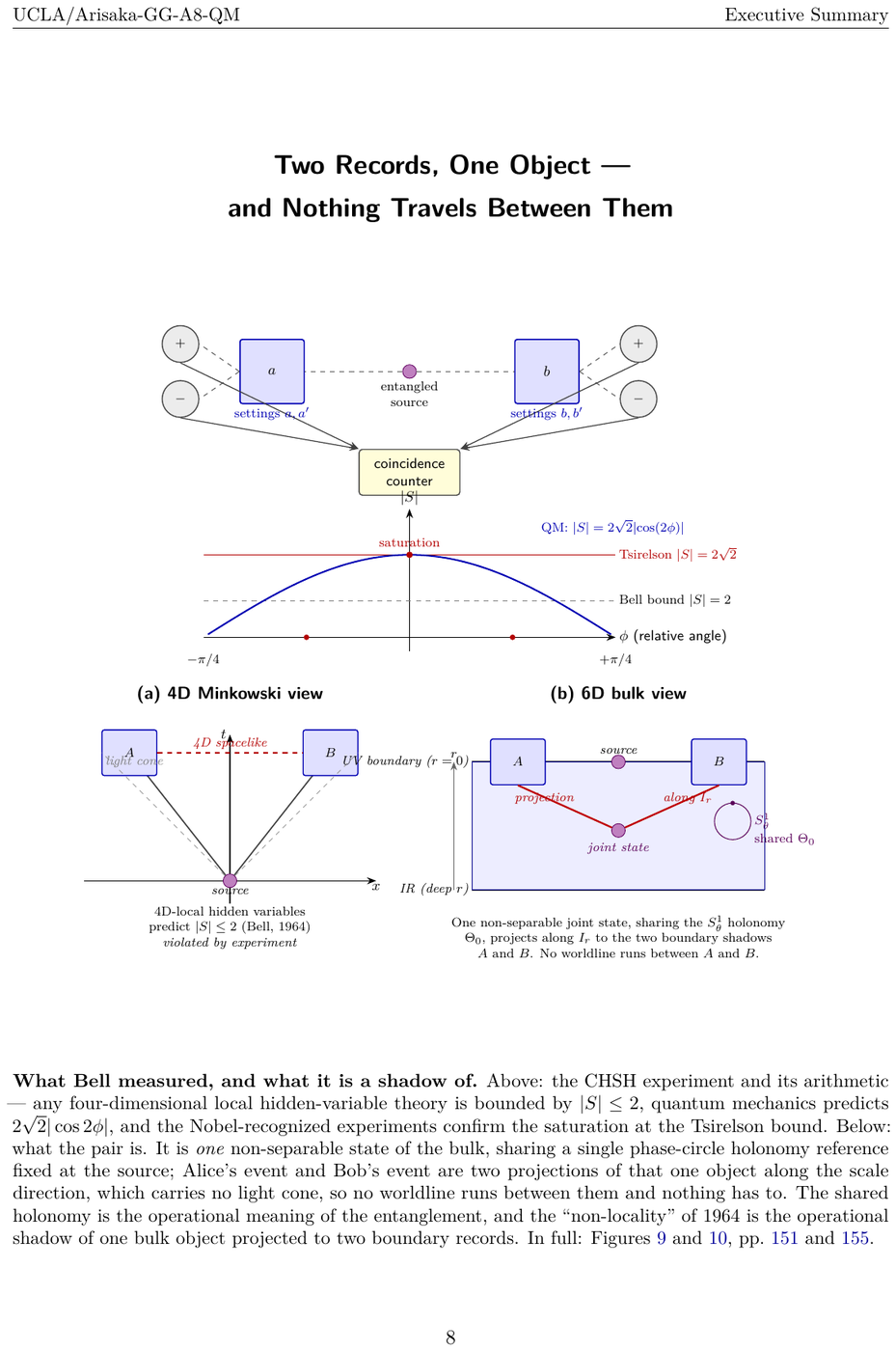
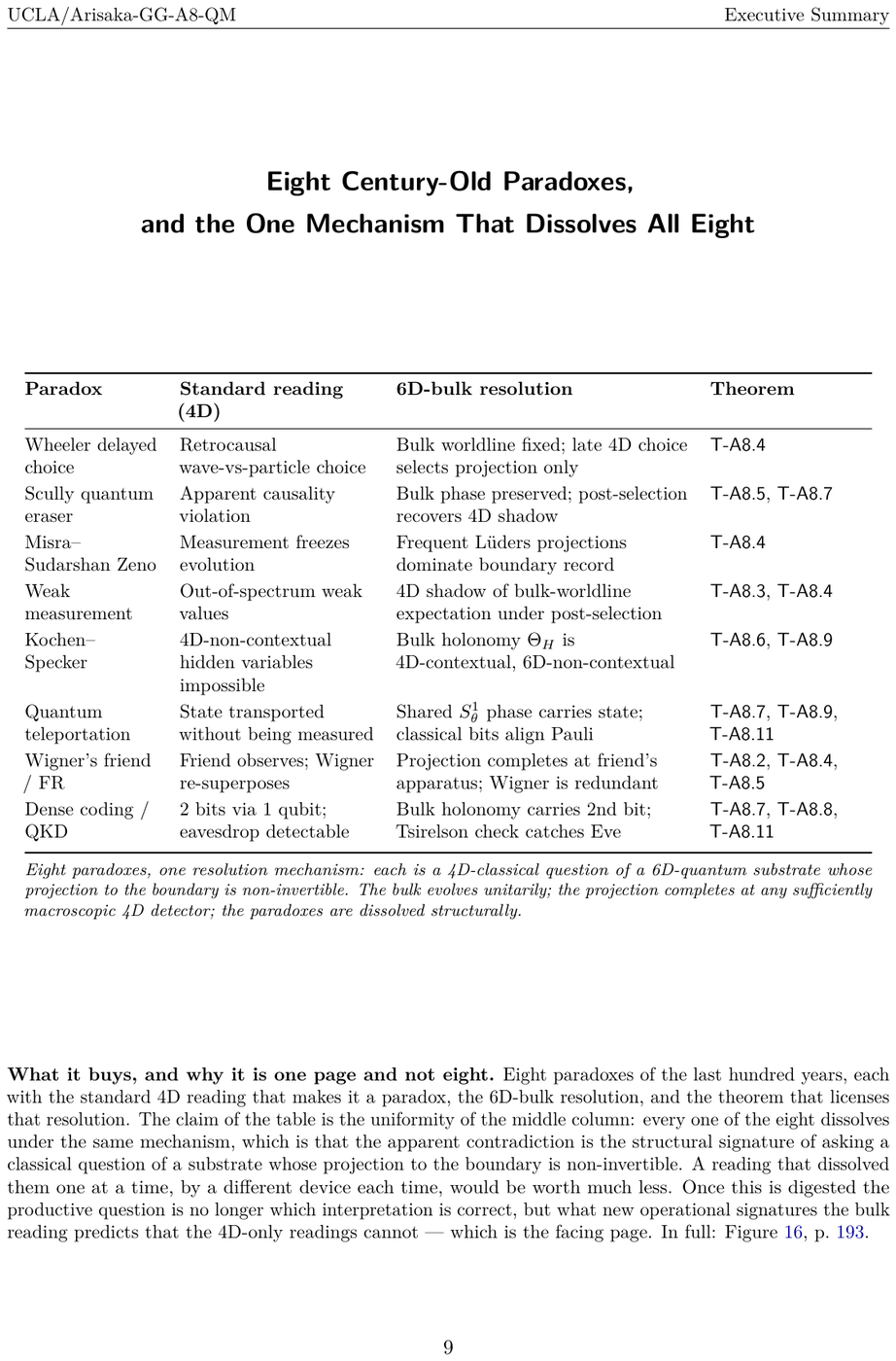
For a century, quantum mechanics has been the most accurately tested theory ever written — and the least understood. It predicts the electron's magnetism to one part in ten trillion, yet no one can quite say why a measurement yields a single definite result, why outcomes appear random, or why two particles far apart are correlated more tightly than any classical theory allows.
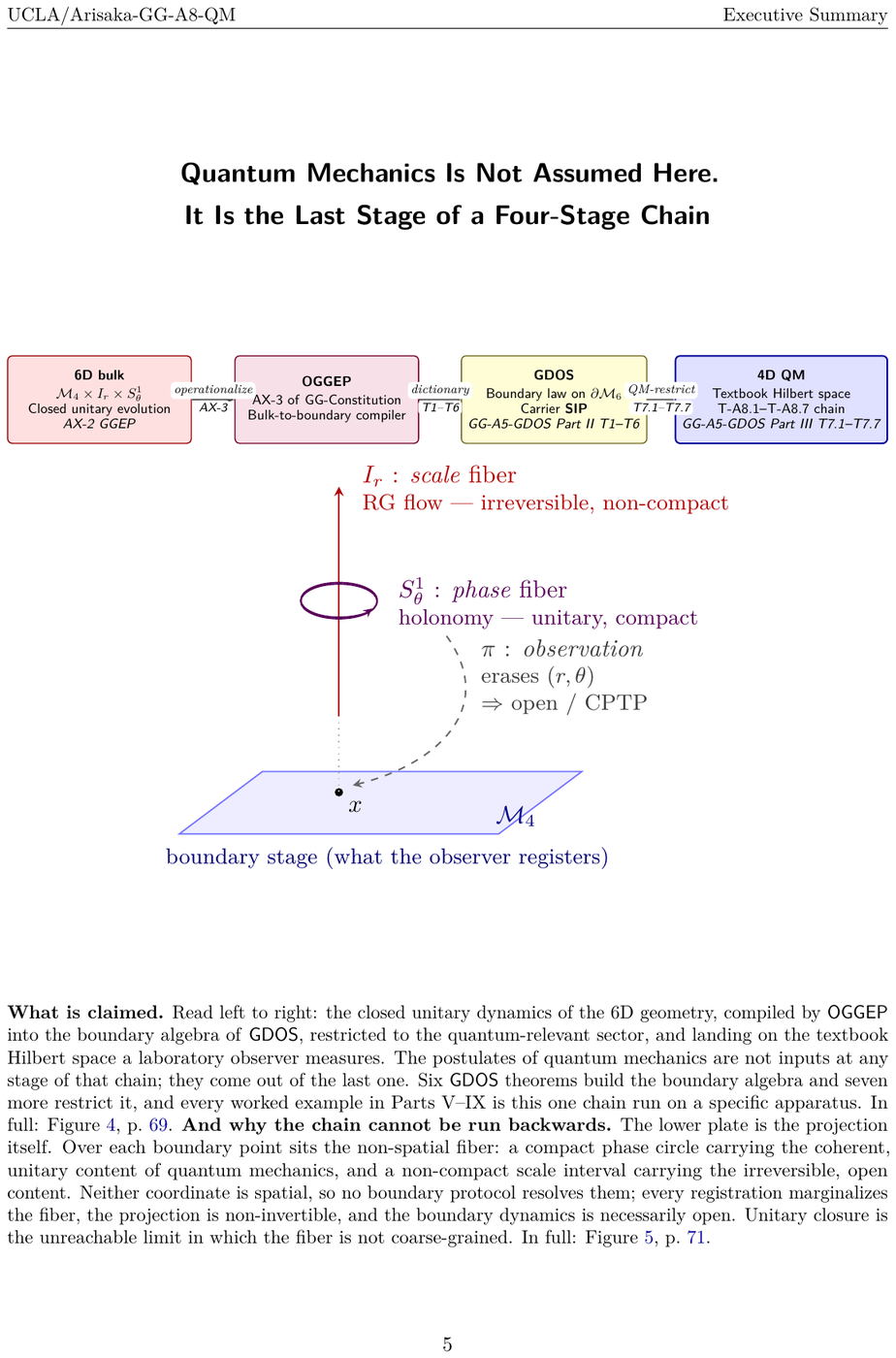
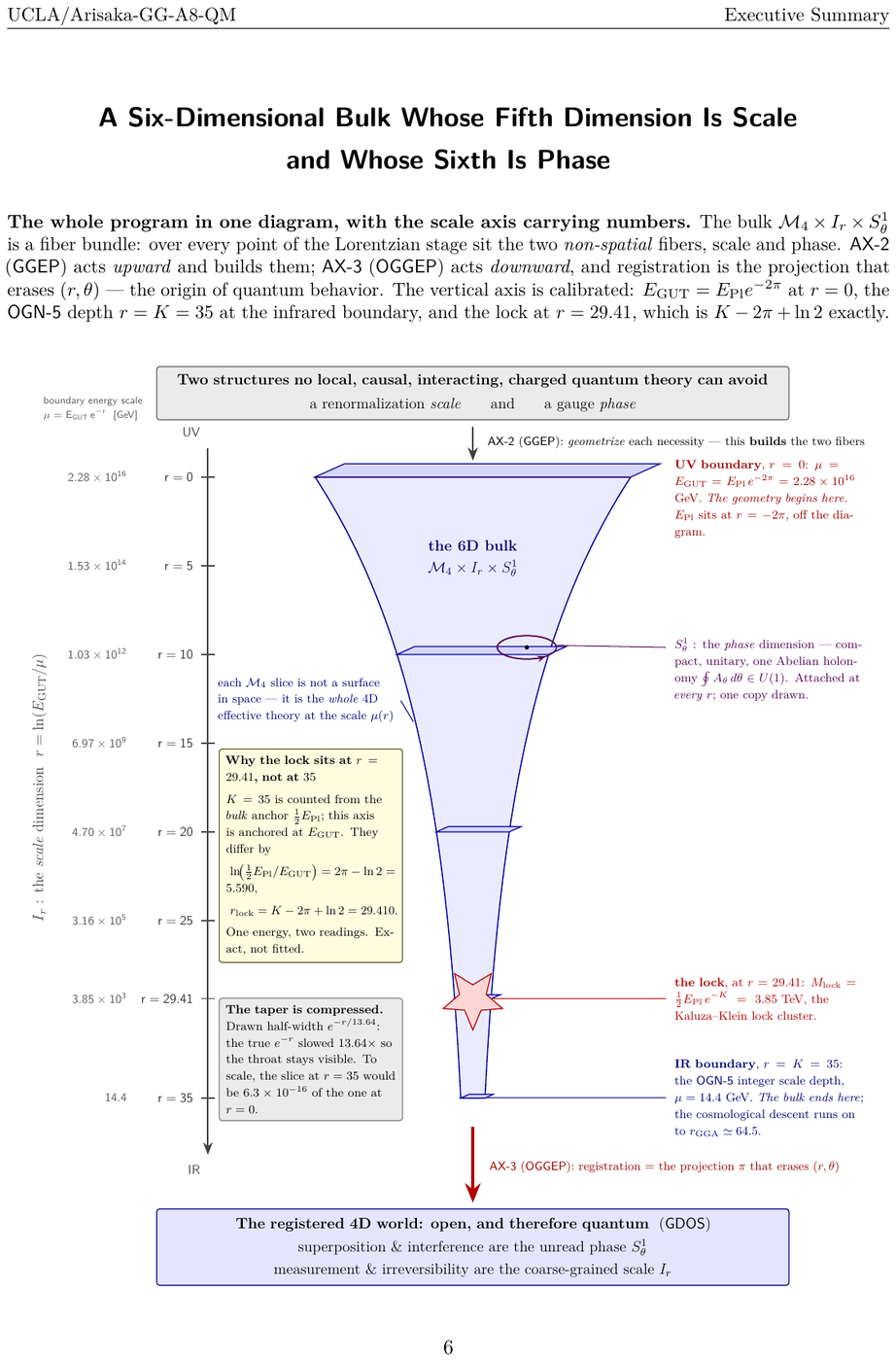
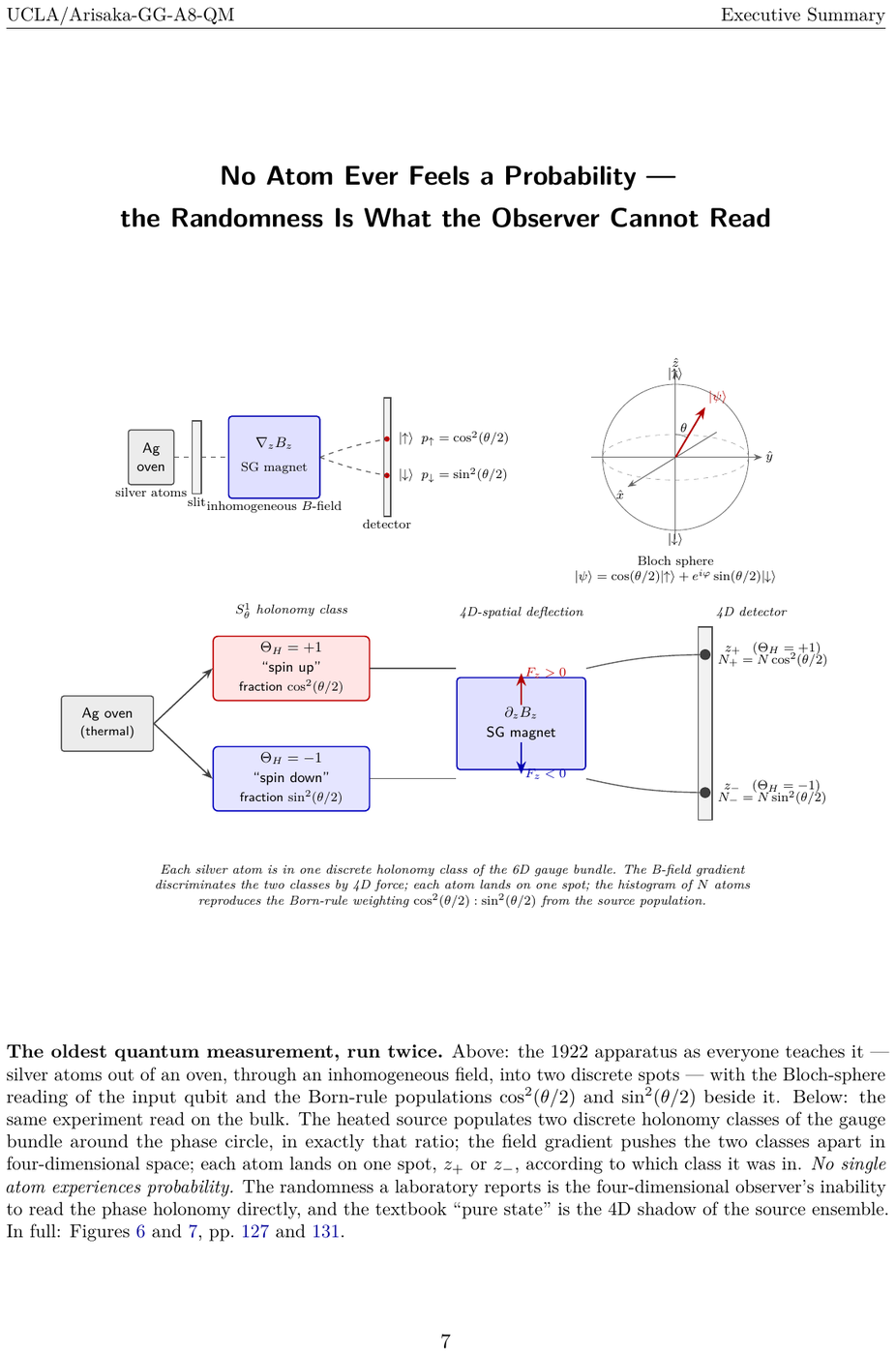
This paper offers one reading of all three. The deeper description of Nature, we propose, is six-dimensional: ordinary spacetime plus two non-spatial geometric directions — a scale dimension, carrying the resolution at which a question is asked, and a phase dimension, carrying the gauge phase that locks matter to force. In that fuller geometry the underlying state is deterministic and constitutionally real, as Einstein hoped — with no complex phase for quantum chance to be written in; it is not, as Bell's theorem requires of any such theory, local. What a four-dimensional observer sees is its projection; every measurement is unavoidably an average over the two hidden directions — the averaging a century of physics has called collapse.
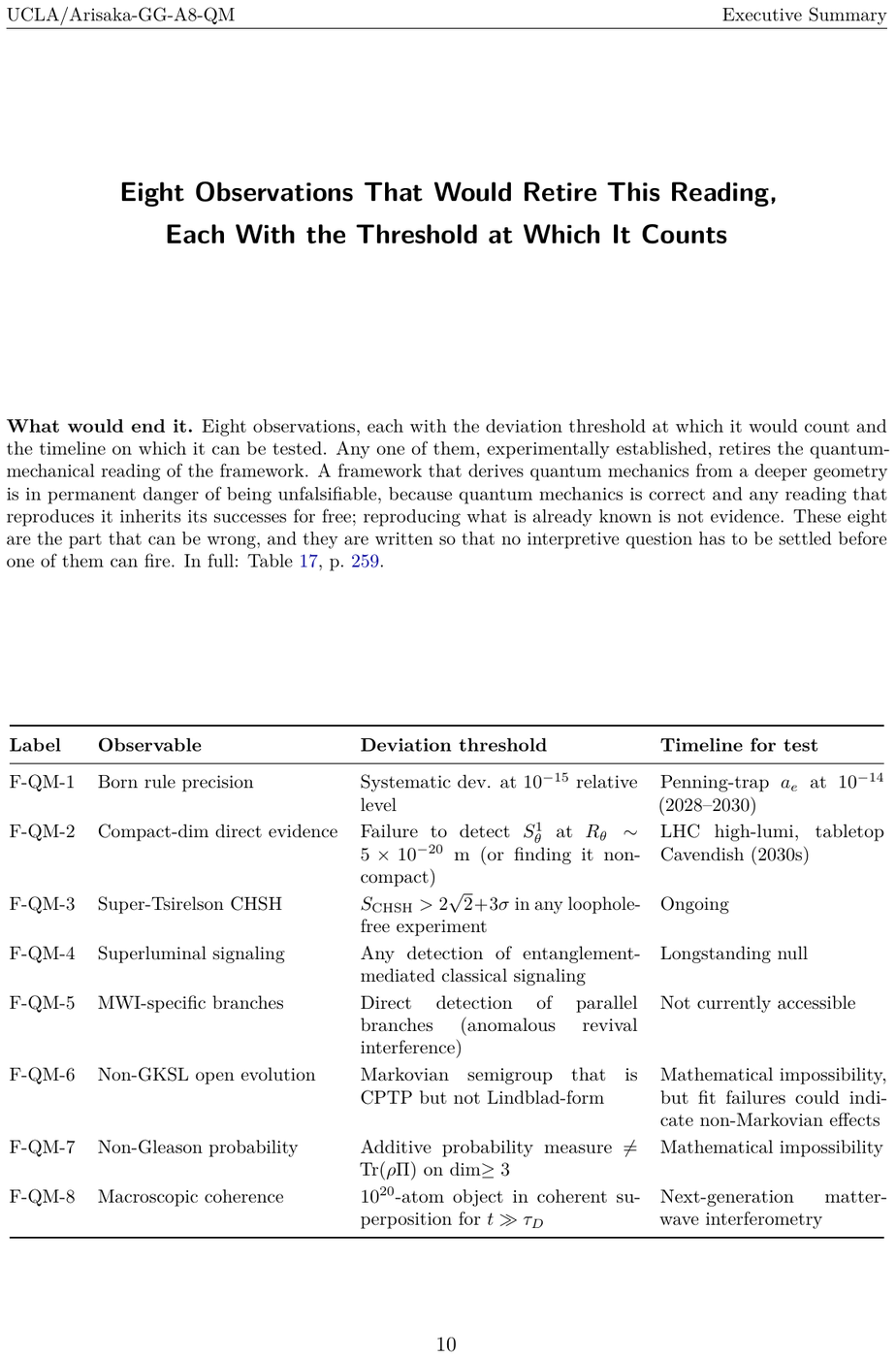
Read this way, the century-old measurement problem becomes three precise questions, each answered by a theorem, and one further question — why outcomes fall in exactly the proportions Born's rule predicts — whose dynamical realization is closed at the relaxation level, as a stated conditional theorem, with one named analytic step remaining. We claim no new laboratory prediction where quantum mechanics already succeeds; we offer a picture in which its deepest strangeness is the shape of a shadow, and the dice — rolled in an imaginary unit made by the same projection — are thrown in two directions our senses can never turn to face.
Keywords
- GRIP-In
- GRIP-Out
- Geometric Attractor (GA)
- Ground Geometric Attractor (GGA)
- Born rule
- Bell inequality
- CHSH
- EPR paradox
- quantum entanglement
- Schrödinger's cat
- double-slit experiment
- Stern-Gerlach experiment
- quantum decoherence
- Lindblad equation
Showcase — 6 pages from the paper
Cite this preprint
@misc{ArisakaA8,
  author       = {Arisaka, Katsushi},
  title        = {Quantum Mechanics Derived from GG-Theory as Projection from 6D Bulk to 4D Boundary},
  year         = {2026},
  note         = {GG-Theory preprint A8, version v23.2},
  doi          = {10.5281/zenodo.22064310},
  url          = {https://preprints.arisaka-gg.org/a8-qm/}
}
K. Arisaka, “Quantum Mechanics Derived from GG-Theory as Projection from 6D Bulk to 4D Boundary”, GG-Theory preprint A8, v23.2 (September 9, 2026). doi:10.5281/zenodo.22064310
The cohort
The Constitution
The GG-6 Trio
The GDOS Trio
The 4D-Physics Trio
The Closing Capstone
Particle Physics Branch
Foundations Branch
Cosmology & Astrophysics
White-Paper Branch