The GG‑6 Lock Cluster
A Non-Spatial Kaluza–Klein Resonance near 3.85 TeV as the Standing LHC Falsifier of GG-Theory
v23.14 · September 9, 2026 · 236 pages
Abstract
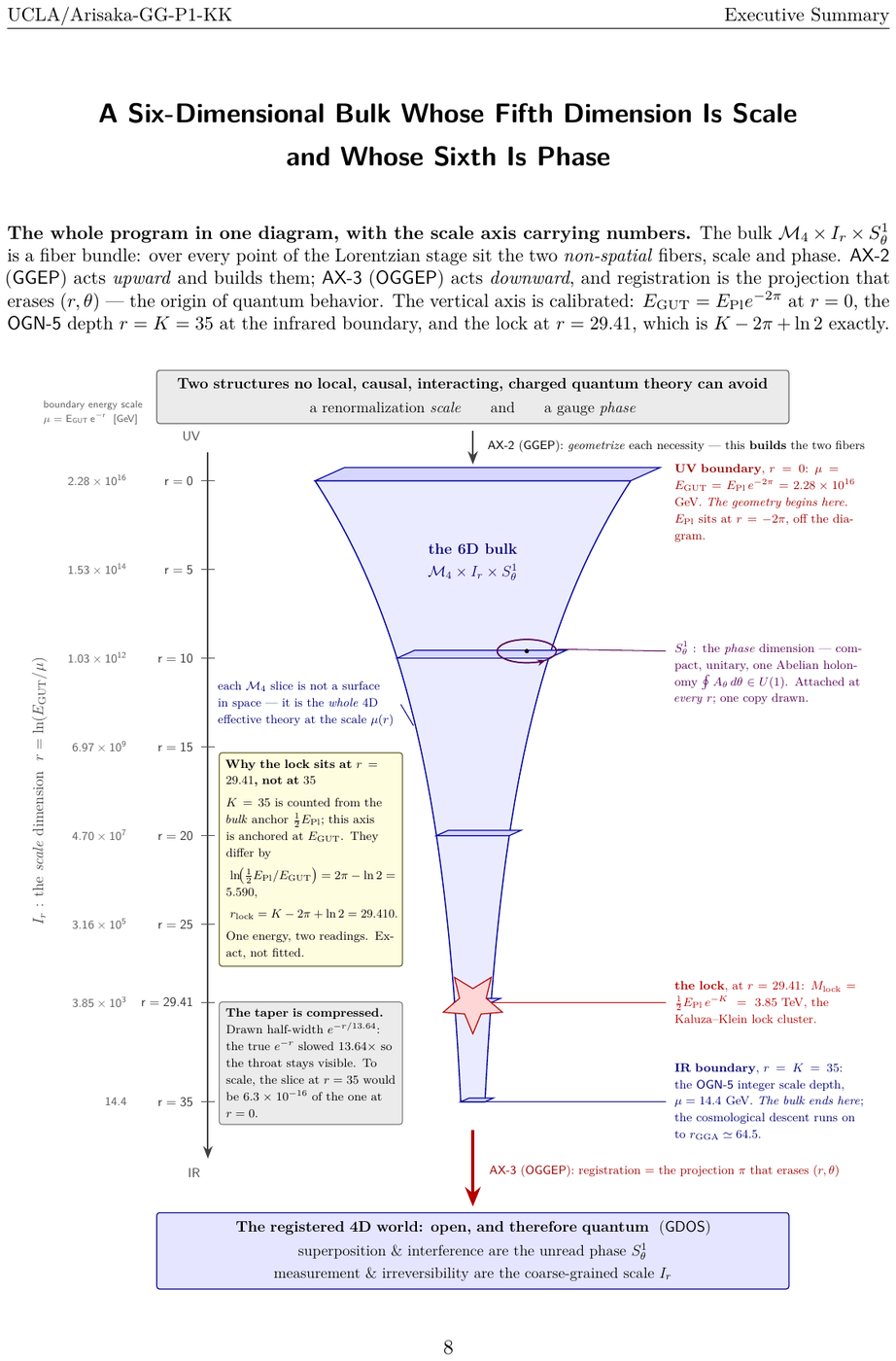
Every particle found since the 1970s was on the Standard Model's list first. This paper is about the first particle that is not on that list. GG-Theory derives, rather than fits, a new mass scale: the lock cluster at M_lock= 12 M_Ple^-35≃3.849 TeV, fixed by the ledger integer K=35 with no adjustable parameter. The same number over-constrains the electroweak scale, v=M_lock(2/5)³≈246 GeV: two known scales, one integer, nowhere to hide.
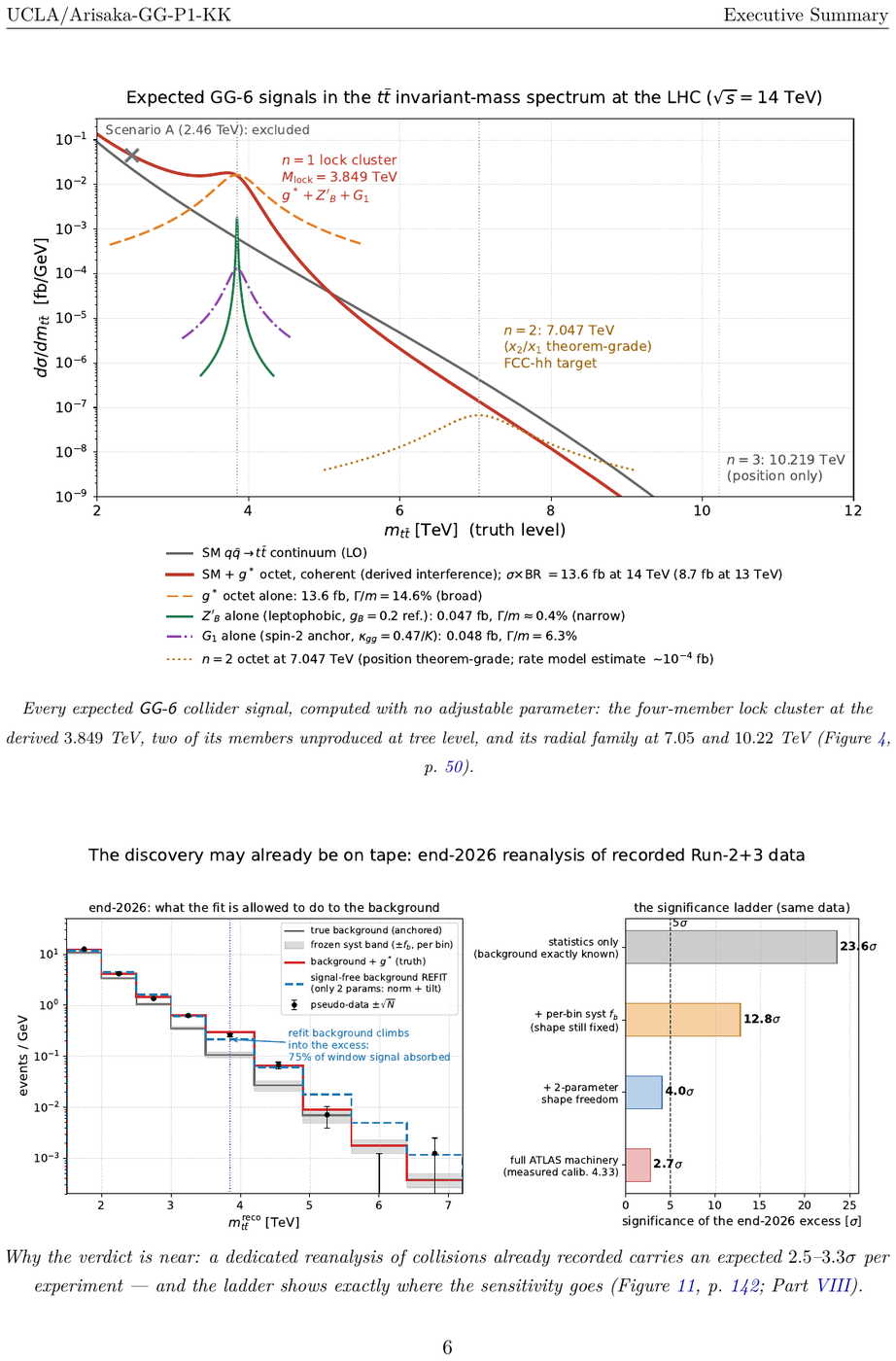
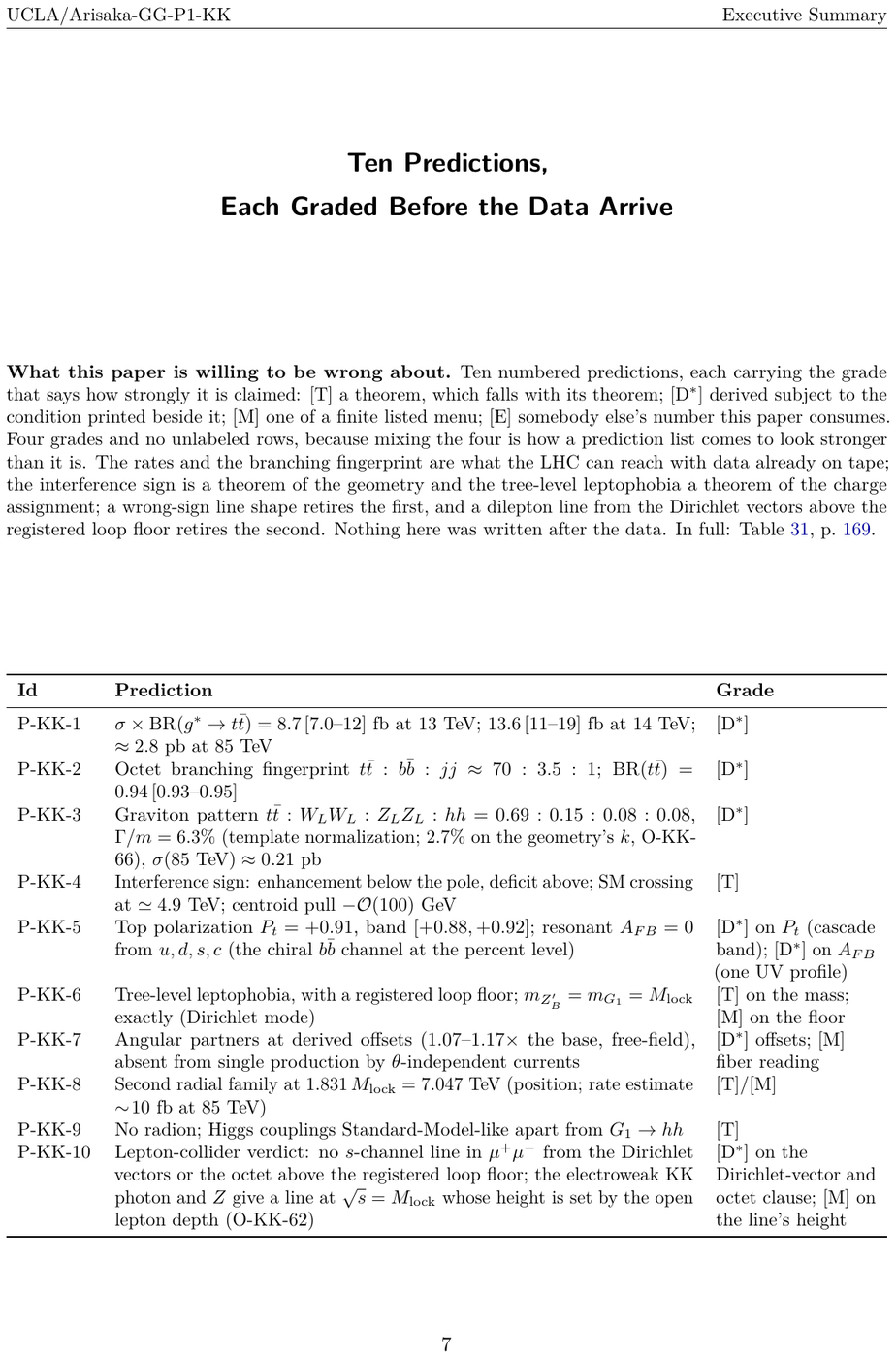
At that mass the theory places a four-member cluster — a spin-2 graviton, a color-octet vector g^*, and two Dirichlet-terminated Abelian vectors (the leptophobic Z'_B and its Qi sibling) that no ordinary quark produces at tree level — the discrete modes of a non-spatial (renormalization-group) extra dimension, top-rich, dijet-friendly, and lepton-poor by derivation, beyond the reach of existing clean-channel limits. The un-suppressible member is the octet — σ×BR(t t)=8.7 fb at 13 TeV, Γ/m=0.146, interference sign fixed — sitting at — and on this paper's own calibration nominally just past — the observed edge of the ATLAS/CMS t t exclusions: the prediction is being tested now.
A full simulation anchored to the ATLAS Run-2 analysis (Part VIII) turns this into a calendar: a dedicated reanalysis of data already on tape carries an expected 2.5–3.3σ per experiment, 4.1–4.7σ for an ATLAS+CMS combination with improved systematics — sensitivity approaching evidence level from existing data — and single-experiment 5σ at ≈1.3 ab⁻¹, around 2034, with halved background systematics. Because every property is pre-registered the search pays no look-elsewhere penalty, and on the same calibration the Run-3 data already recorded (≃0.5 ab⁻¹) are expected to exclude the whole band if it is empty, retiring the implementation outright. One exposure rides with the bet: against the infrared-registered Higgs, the tower's electroweak members give T = 1.7 where the fit allows 0.00±0.06, with no custodial symmetry available (O-KK-68). The mass is the bet; the LHC is the table.
Keywords
- geometry–gauge locking
- Kaluza–Klein particles
- non-spatial extra dimensions
- scale dimension
- phase dimension
- Randall–Sundrum
- ATLAS
- CMS
- HL-LHC
- spin-2 resonance
- top-antitop resonances
- trigger-level analysis
- data scouting
- falsifiability
Showcase — 3 pages from the paper
Cite this preprint
@misc{ArisakaP1,
  author       = {Arisaka, Katsushi},
  title        = {The GG-6 Lock Cluster},
  year         = {2026},
  note         = {GG-Theory preprint P1, version v23.14},
  doi          = {10.5281/zenodo.22064321},
  url          = {https://preprints.arisaka-gg.org/p1-kk/}
}
K. Arisaka, “The GG-6 Lock Cluster”, GG-Theory preprint P1, v23.14 (September 9, 2026). doi:10.5281/zenodo.22064321
The cohort
The Constitution
The GG-6 Trio
The GDOS Trio
The 4D-Physics Trio
The Closing Capstone
Particle Physics Branch
Foundations Branch
Cosmology & Astrophysics
White-Paper Branch