The Kaxion
Cold Dark Matter as the Non-Spatial Compact-Angle Pseudoscalar of GG-6
v23.14 · September 9, 2026 · 302 pages
Abstract
Nearly a century ago, astronomers found that galaxies move as though they hold far more matter than we can see. Stars at the edges of spinning galaxies orbit too fast; the afterglow of the Big Bang bears the imprint of a substance outweighing ordinary atoms five to one. We call it dark matter, and no experiment has yet identified what it is.
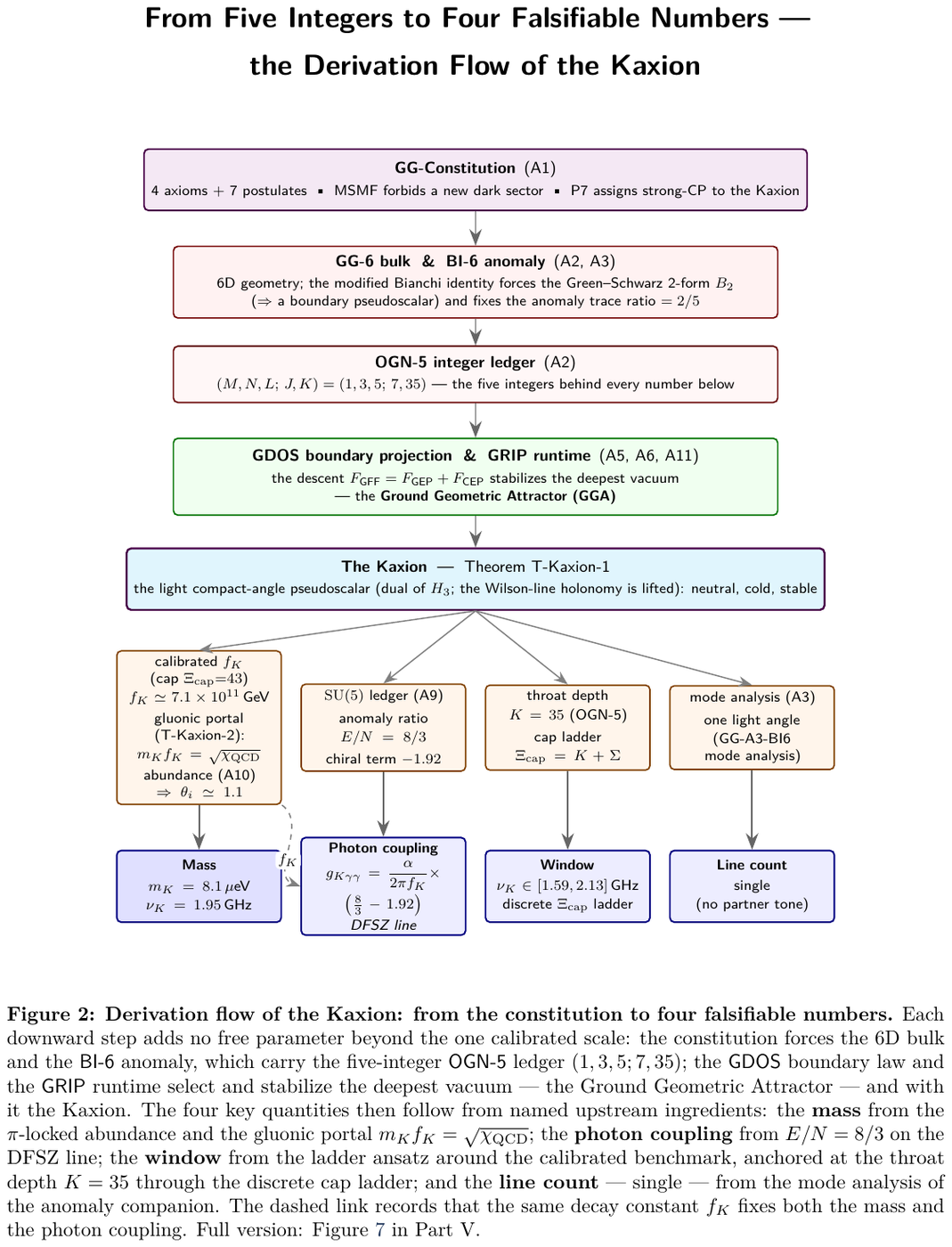
This paper offers an answer not invented for the purpose. In earlier papers of this series we built a theory from a few founding rules and showed that, with no adjustable numbers, it reproduces the known particles and forces. That same construction is forced to contain one more field: an exceedingly light, electrically neutral relic of the geometry we call the Kaxion. It is automatically dark, stable, and cold, and the early universe makes it by the standard mechanism; requiring it to make just the observed amount — about 27 percent of the cosmos — fixes the one scale the geometry has not yet supplied. It also helps relax the strong nuclear force's vacuum angle to zero — a job the construction was not built to do.
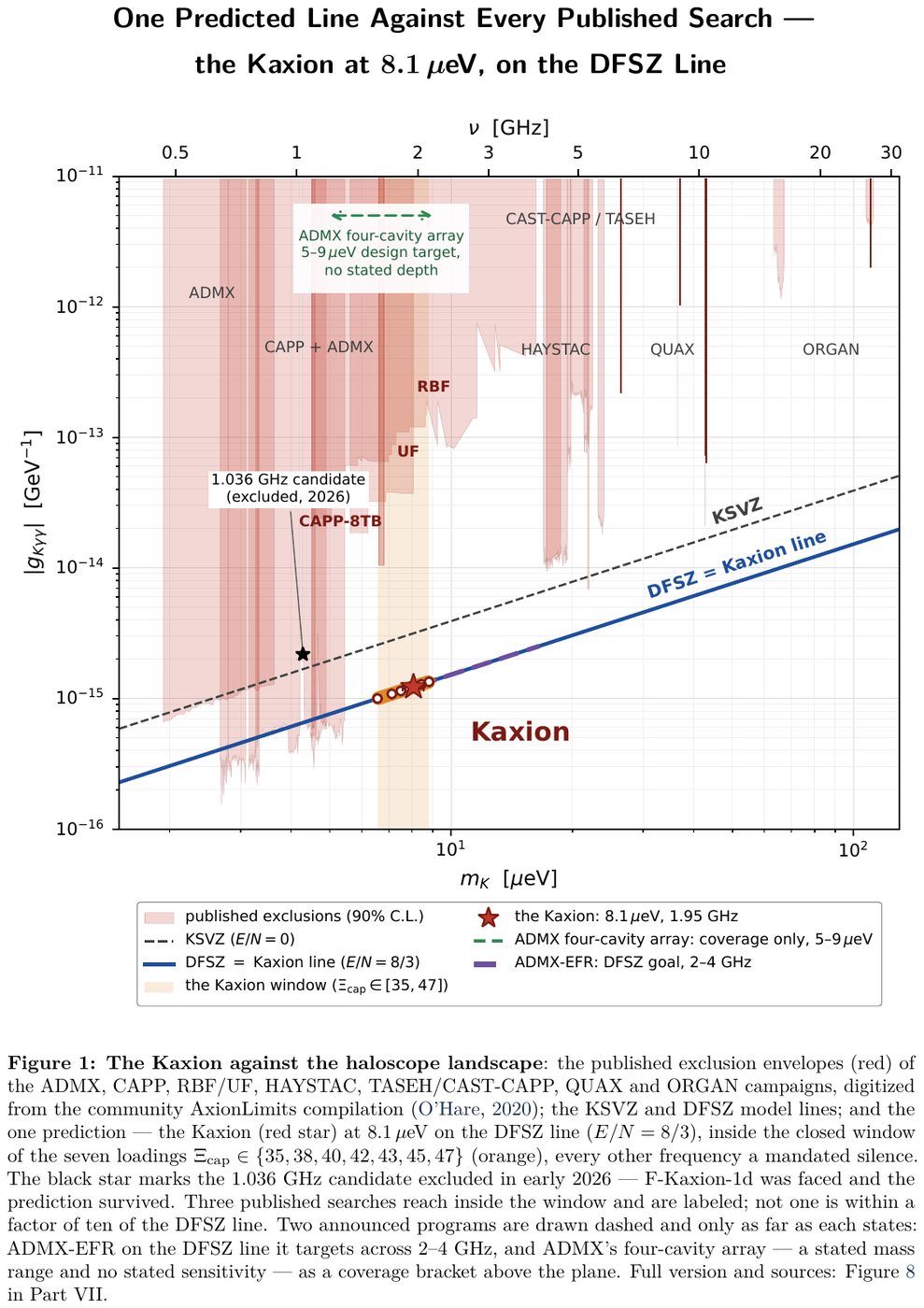
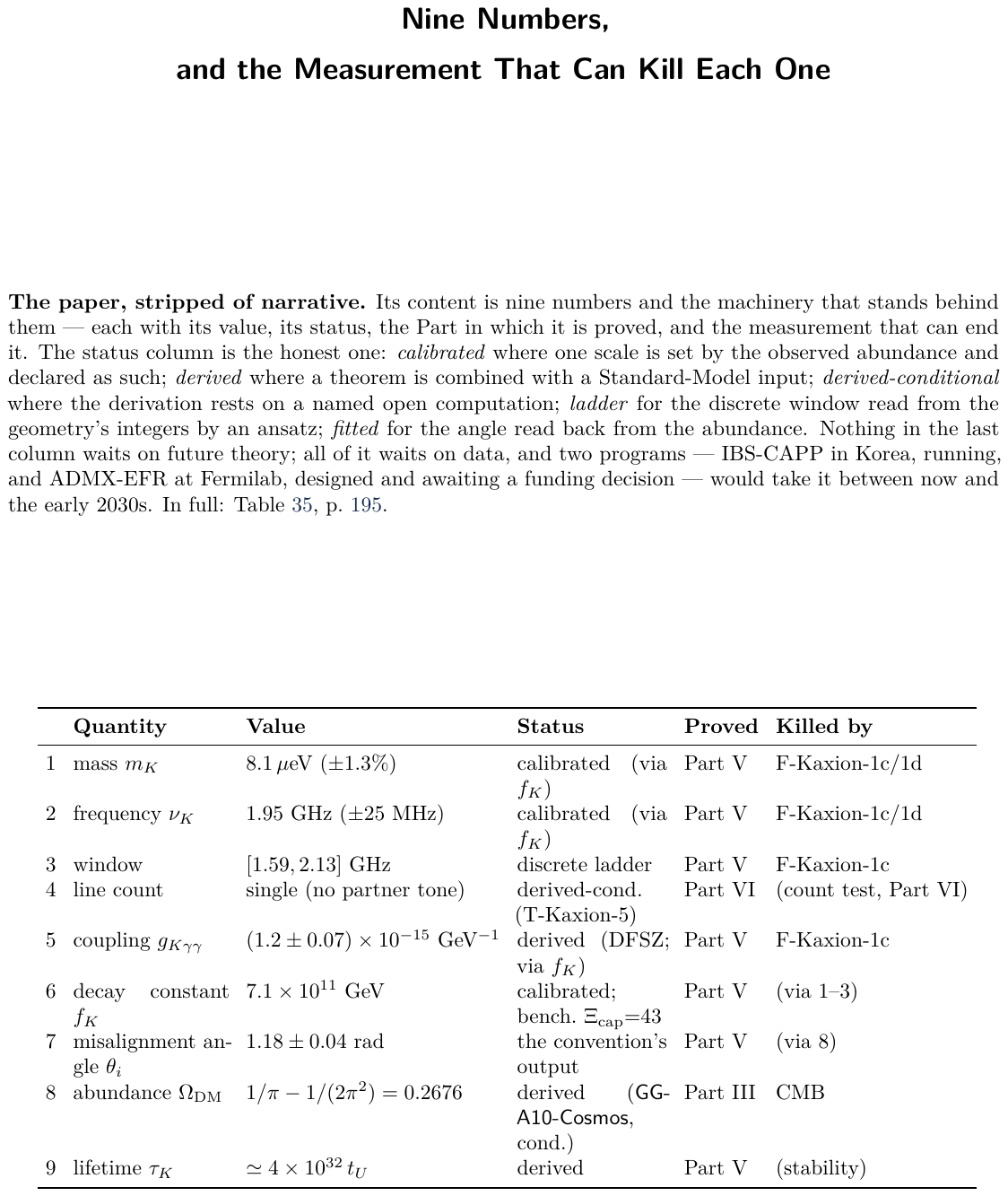
With that one scale set and nothing else free to tune, the theory is committed to three things: the mass, 8.1 μeV, and with it the microwave frequency at which to listen, near 1.95 GHz, inside a narrow band; the faintness of its glow into light; and a count — one note, standing alone inside that band, with no partner tone at any spacing. Two programs aimed at this band — one running, one designed — would together reach this frequency and faintness, and would then either find the Kaxion or close the window. If they do, the substance that first gathered the galaxies will have been sounding one faint note since the universe's opening microsecond — a pitch set by one calibration and a handful of whole numbers.
Keywords
- GG-Theory
- GG-6
- BI-6
- OGN-5 integer ledger (1,3,5;7,35)
- GRIP
- non-spatial compact angle
- Green–Schwarz mechanism
- Kaxion
- dark matter
- strong CP
- Ω_DM=1/π-1/(2π²)
- misalignment
- haloscope
- single line
Showcase — 3 pages from the paper
Cite this preprint
@misc{ArisakaC1,
  author       = {Arisaka, Katsushi},
  title        = {The Kaxion},
  year         = {2026},
  note         = {GG-Theory preprint C1, version v23.14},
  doi          = {10.5281/zenodo.22064333},
  url          = {https://preprints.arisaka-gg.org/c1-kaxion/}
}
K. Arisaka, “The Kaxion”, GG-Theory preprint C1, v23.14 (September 9, 2026). doi:10.5281/zenodo.22064333
The cohort
The Constitution
The GG-6 Trio
The GDOS Trio
The 4D-Physics Trio
The Closing Capstone
Particle Physics Branch
Foundations Branch
Cosmology & Astrophysics
White-Paper Branch