The Standard Model as Theorem of GG‑Theory
Its 28 Parameters as Observations of One Six-Dimensional Geometry
v25.1 · September 11, 2026 · 646 pages
Abstract
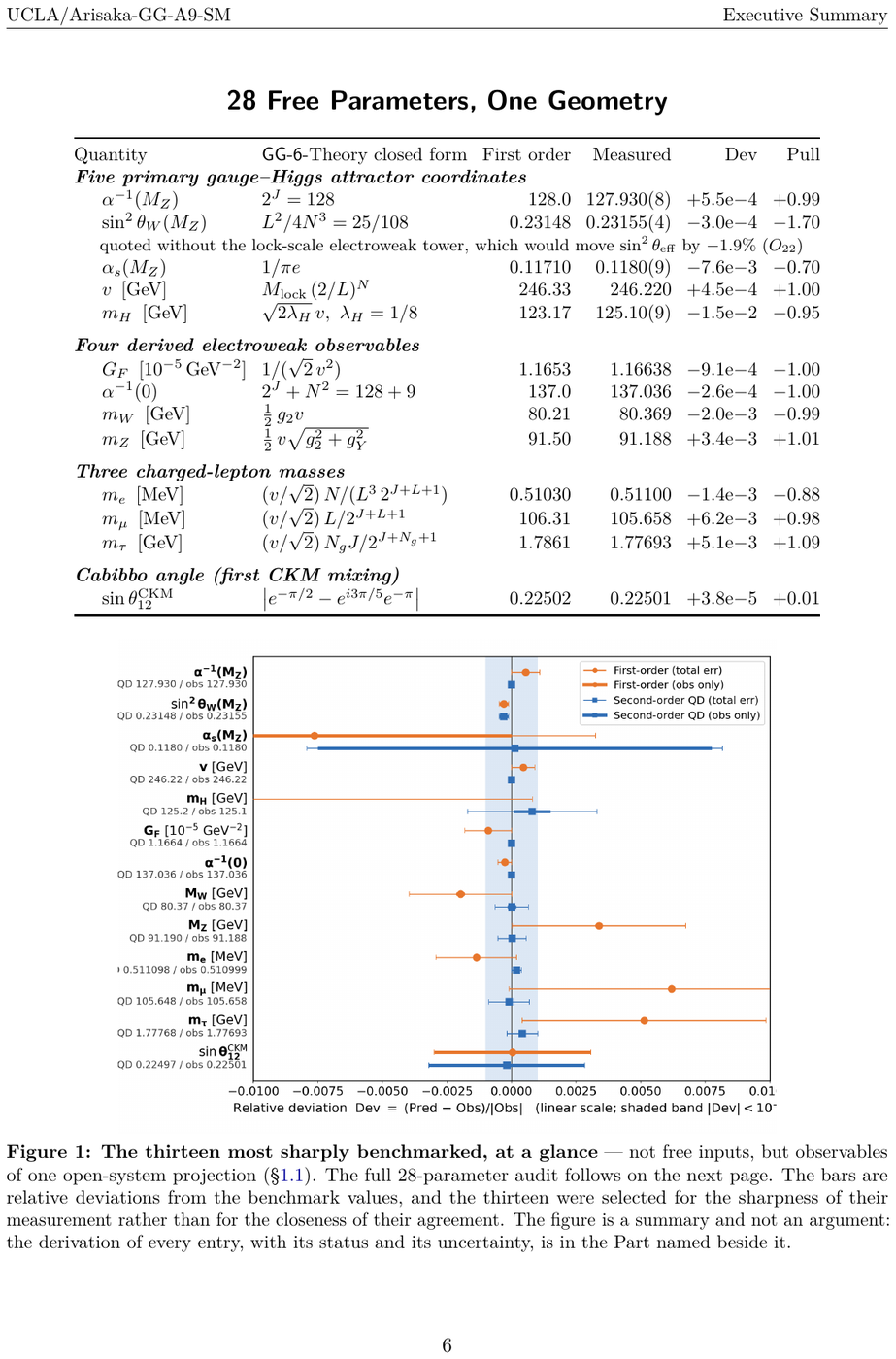
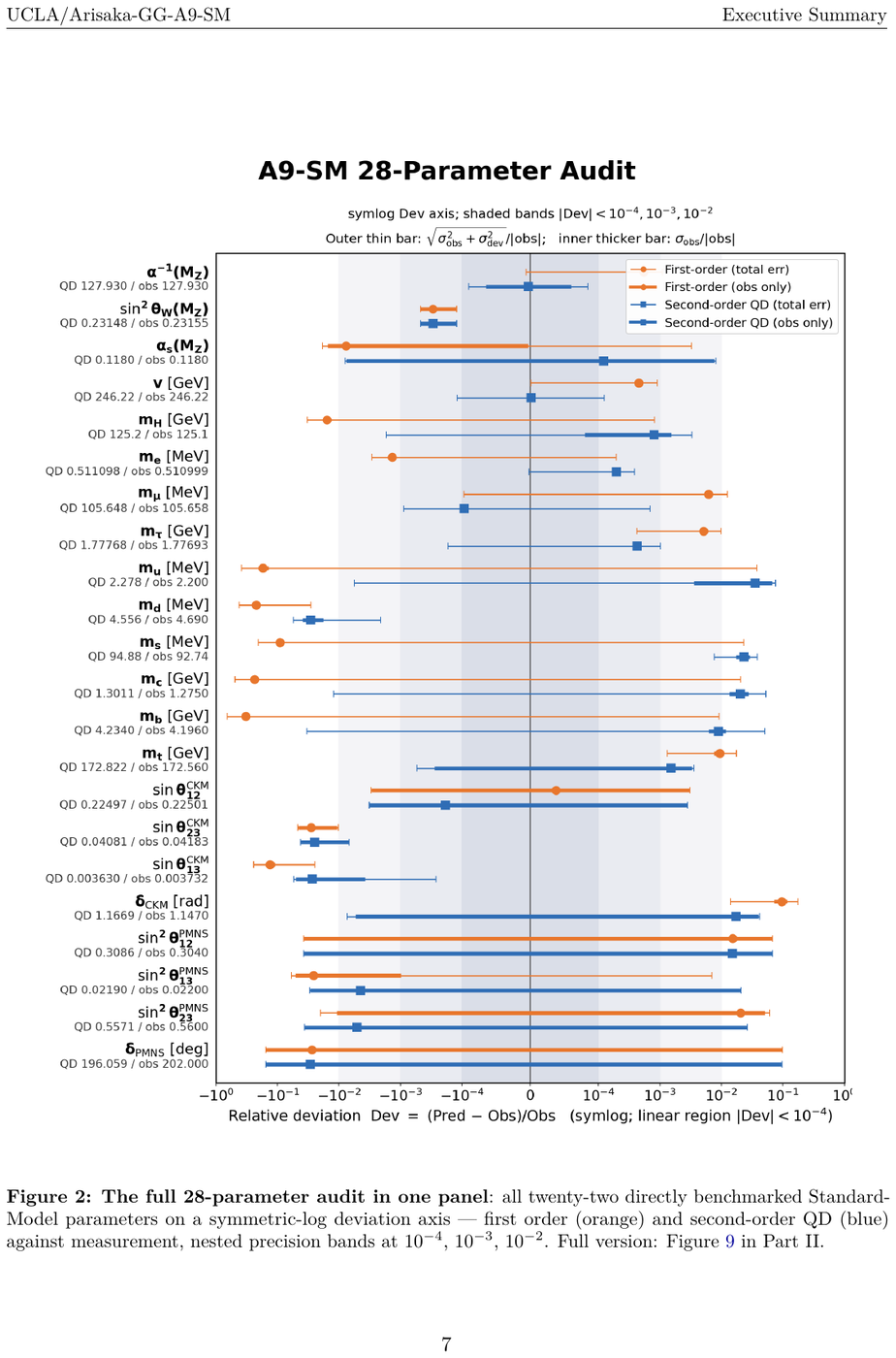
The Standard Model is the most successful theory ever built and the most unsatisfying: it predicts experiment to extraordinary precision, yet cannot say where its own numbers come from. Twenty-eight quantities — the masses of the particles, the strengths of the forces, the angles that decide how one particle turns into another — must be measured and put in by hand.
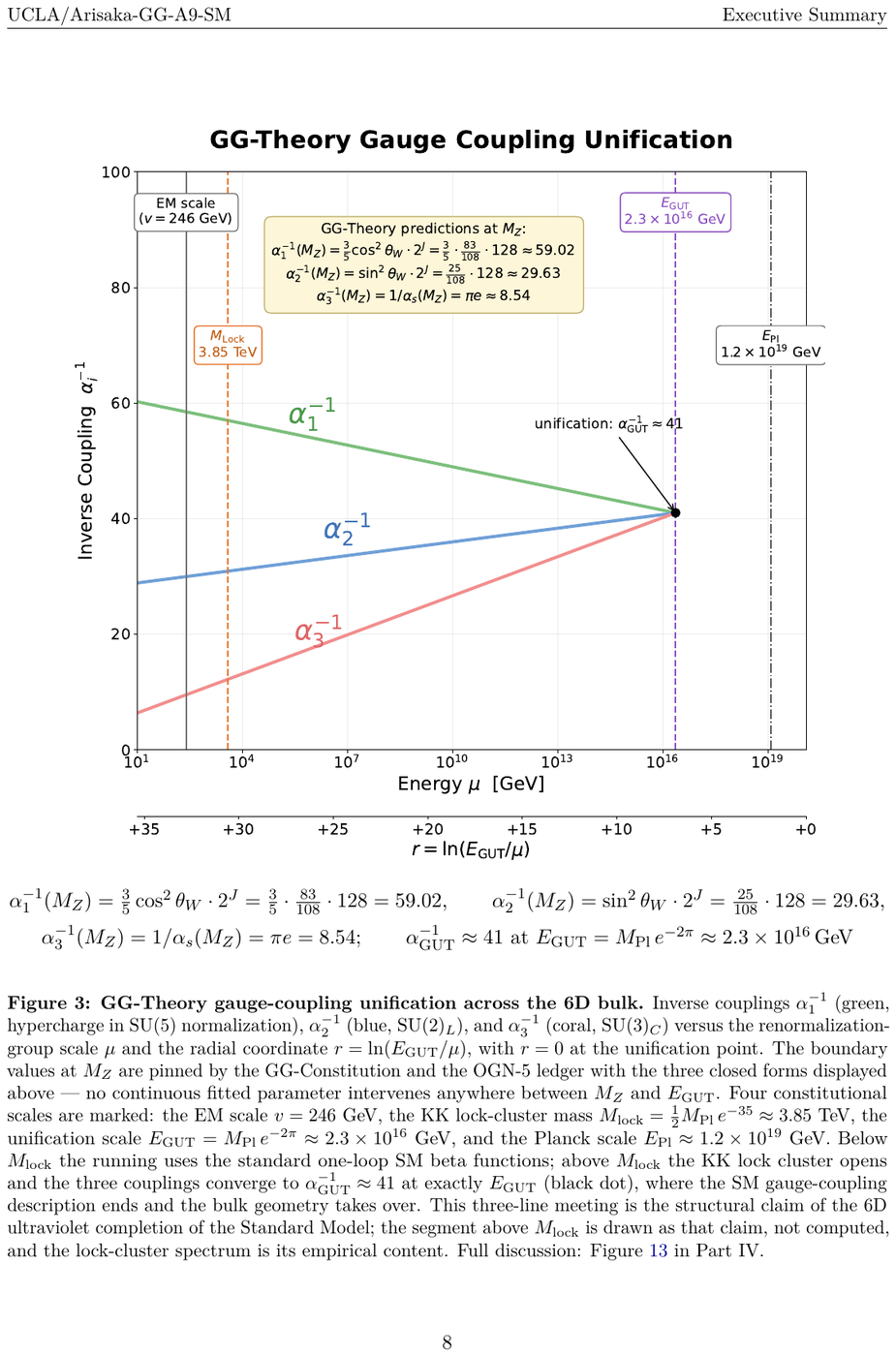
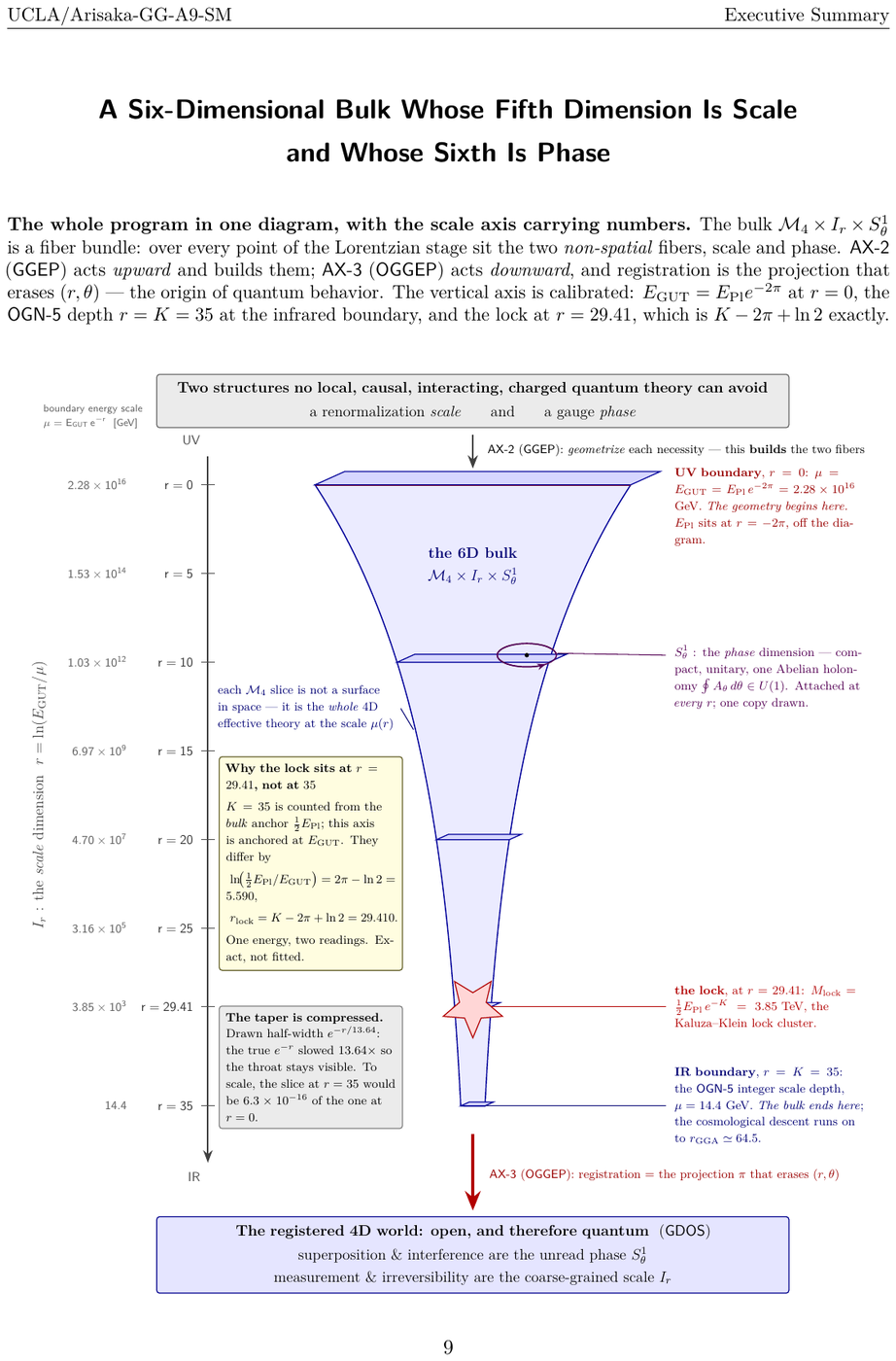
This paper argues that those numbers are not free choices of nature but observations. Nothing in nature is ever truly isolated — not even a single particle — so the four-dimensional world we measure is a projection of a deeper six-dimensional one, fixed once and carrying no adjustable dials. Measurement is that projection in action, and the twenty-eight are not dials set by hand but values it must return: where the textbook sees accidents, the geometry sees theorems.
Two limits are stated at the outset. The list of particles the world contains follows from the same geometry, except for the Higgs, whose place in it is chosen for economy rather than forced. And the number measuring how far the strong nuclear force distinguishes matter from antimatter — known to be smaller than a billionth — is fixed here only to a choice between two values, that choice settled by a slow relaxation carried in a companion paper.
Some follow from the geometry outright, others once a single named step is supplied, and the rest are marked honestly as still open. Nothing is tuned after the fact: one short list of integers must serve all twenty-eight at once, so the result is forced rather than fitted — propositions descending from a fixed starting point, in the spirit of Euclid.
If this holds, a deeper question becomes fair: why these values, why four forces, why every electron is identical? The paper reads all three as one statement of uniqueness — a world that is as it is not by luck, but because the geometry allows no other.
Keywords
- GG-Theory
- GG-Constitution
- GG-6 bulk
- GRIP-In (fixed-landscape regime)
- GRIP-Out (landscape-reorganizing regime)
- BI-6 anomaly identity
- OGN-5 integer ledger
- GDOS boundary law
- Gi-4 pillars (TGG, CCI, GFF, GRIP)
- Qi-4 pillars and Arisaka equation
- Q_B as GU-5 anchor
- GRIP cascade DGI → GSSB → GA
- family number N_g = 3 as theorem
- cascade-depth Yukawa hierarchy on CP²
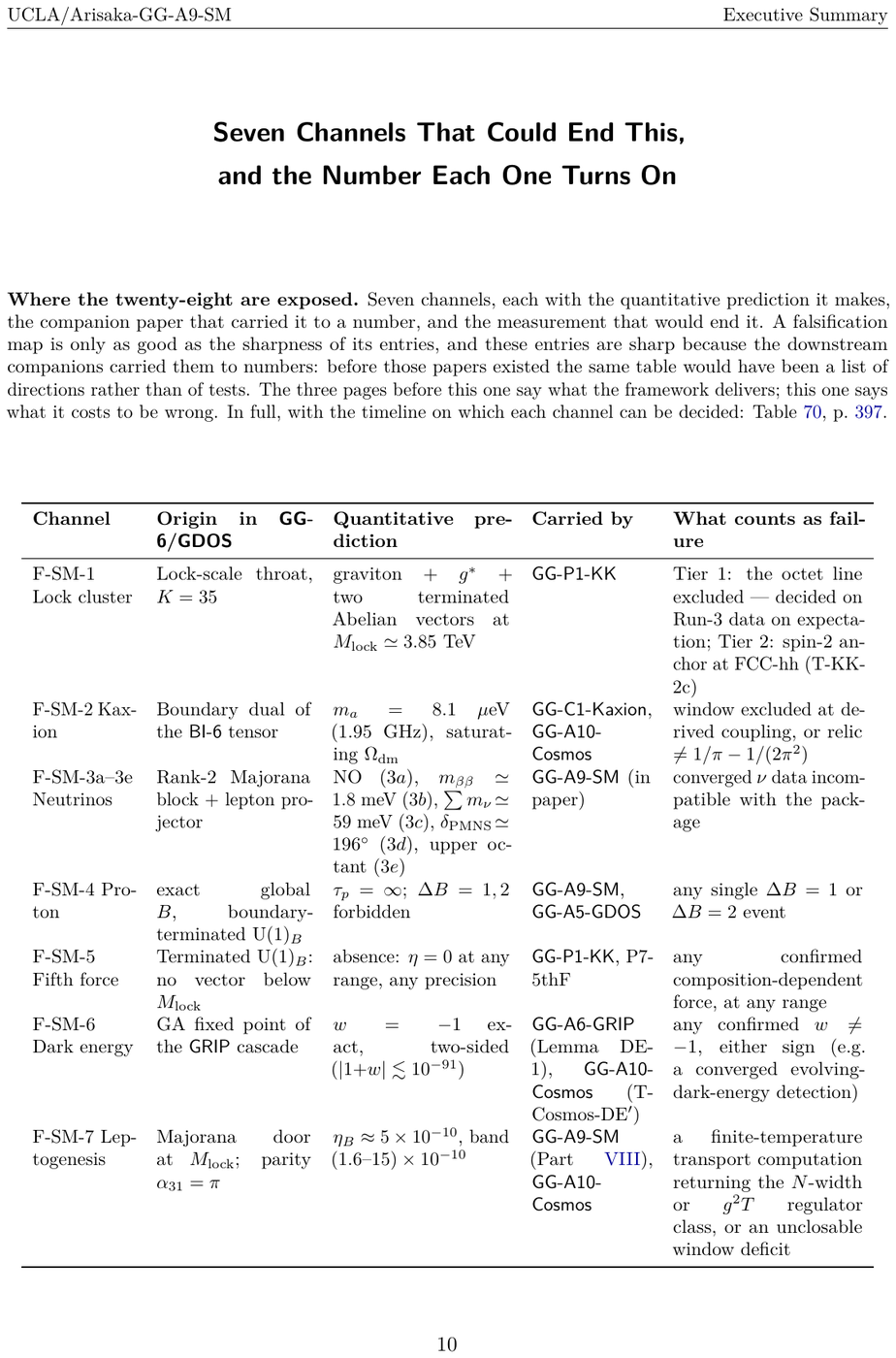
Showcase — 5 pages from the paper
Cite this preprint
@misc{ArisakaA9,
  author       = {Arisaka, Katsushi},
  title        = {The Standard Model as Theorem of GG-Theory},
  year         = {2026},
  note         = {GG-Theory preprint A9, version v25.1},
  doi          = {10.5281/zenodo.22064312},
  url          = {https://preprints.arisaka-gg.org/a9-sm/}
}
K. Arisaka, “The Standard Model as Theorem of GG-Theory”, GG-Theory preprint A9, v25.1 (September 11, 2026). doi:10.5281/zenodo.22064312
The cohort
The Constitution
The GG-6 Trio
The GDOS Trio
The 4D-Physics Trio
The Closing Capstone
Particle Physics Branch
Foundations Branch
Cosmology & Astrophysics
White-Paper Branch