Why Three Generations
A Three-Leg Derivation of N_g=3 from BI-6, MSMF, and GDOS Morse Stability
v23.1 · September 2, 2026 · 129 pages
Abstract
Everything ordinary in the universe is built from the first family of matter particles: the electron, the up quark, the down quark, and their neutrino. Yet nature manufactured two heavier copies of that family — and then stopped. Why three? For half a century the Standard Model has carried the number 3 as an unexplained input: nothing in its equations prefers three families to two or to seventeen.
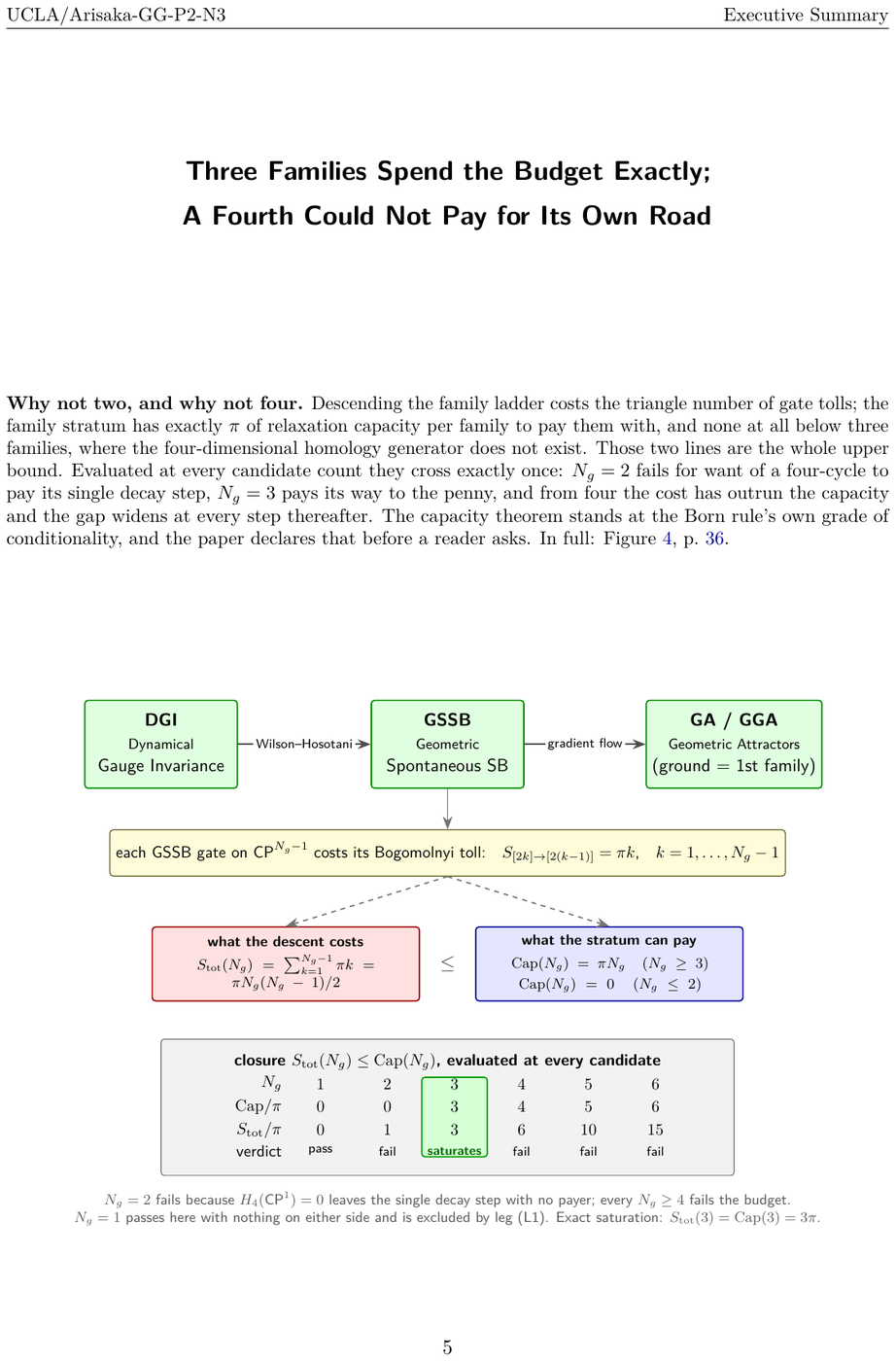
This paper derives it within Grand Geometric Theory (GG-Theory). Three independent directions of constraint close on one value. The observed violation of matter–antimatter symmetry requires at least three families. The relaxation capacity of the family stratum — proved here to be π of instanton budget per family, from the quantum geometry that the boundary's own adiabatic theorem forces on the family moduli — admits at most three: relaxation to the ground family runs through the weak interaction, and a fourth family's road would cost more than the stratum can pay. And the same integer, fed into the theory's mass formulas, reproduces all twelve charged-fermion masses to four significant figures. Every fence is declared: two empirical inputs, premises shared with the Born rule, and the coupling clause — which is no longer assumed but enforced, by a pushforward of the bulk's anomaly data onto the boundary's own geometry that also discharges the paper's one topological residue and closes both of its scope refinements at class level. The integrality statement is derived, its lattice forced by the bulk's spin structure.
After all, a number that nature has held fixed through every experiment ever performed deserves better than to be an input; it deserves to be a theorem.
Keywords
- three generations
- family number
- N_g=3
- MSMF
- GDOS
- Morse theory
- CP^N_g-1
- family-projector moduli
- BI-6
- OGN-5
- fermion mass codebook
- Kobayashi–Maskawa
- Jarlskog invariant
- GFF cascade
Showcase — 1 page from the paper
Cite this preprint
@misc{ArisakaP2,
  author       = {Arisaka, Katsushi},
  title        = {Why Three Generations},
  year         = {2026},
  note         = {GG-Theory preprint P2, version v23.1},
  doi          = {10.5281/zenodo.22064323},
  url          = {https://preprints.arisaka-gg.org/p2-n3/}
}
K. Arisaka, “Why Three Generations”, GG-Theory preprint P2, v23.1 (September 2, 2026). doi:10.5281/zenodo.22064323
The cohort
The Constitution
The GG-6 Trio
The GDOS Trio
The 4D-Physics Trio
The Closing Capstone
Particle Physics Branch
Foundations Branch
Cosmology & Astrophysics
White-Paper Branch