The Mirrors of Matter
Why Every Particle Has a Twin, Why Nature's Mirrors Break, and Why the Universe Is Made of Matter
v23.2 · September 9, 2026 · 356 pages
Abstract
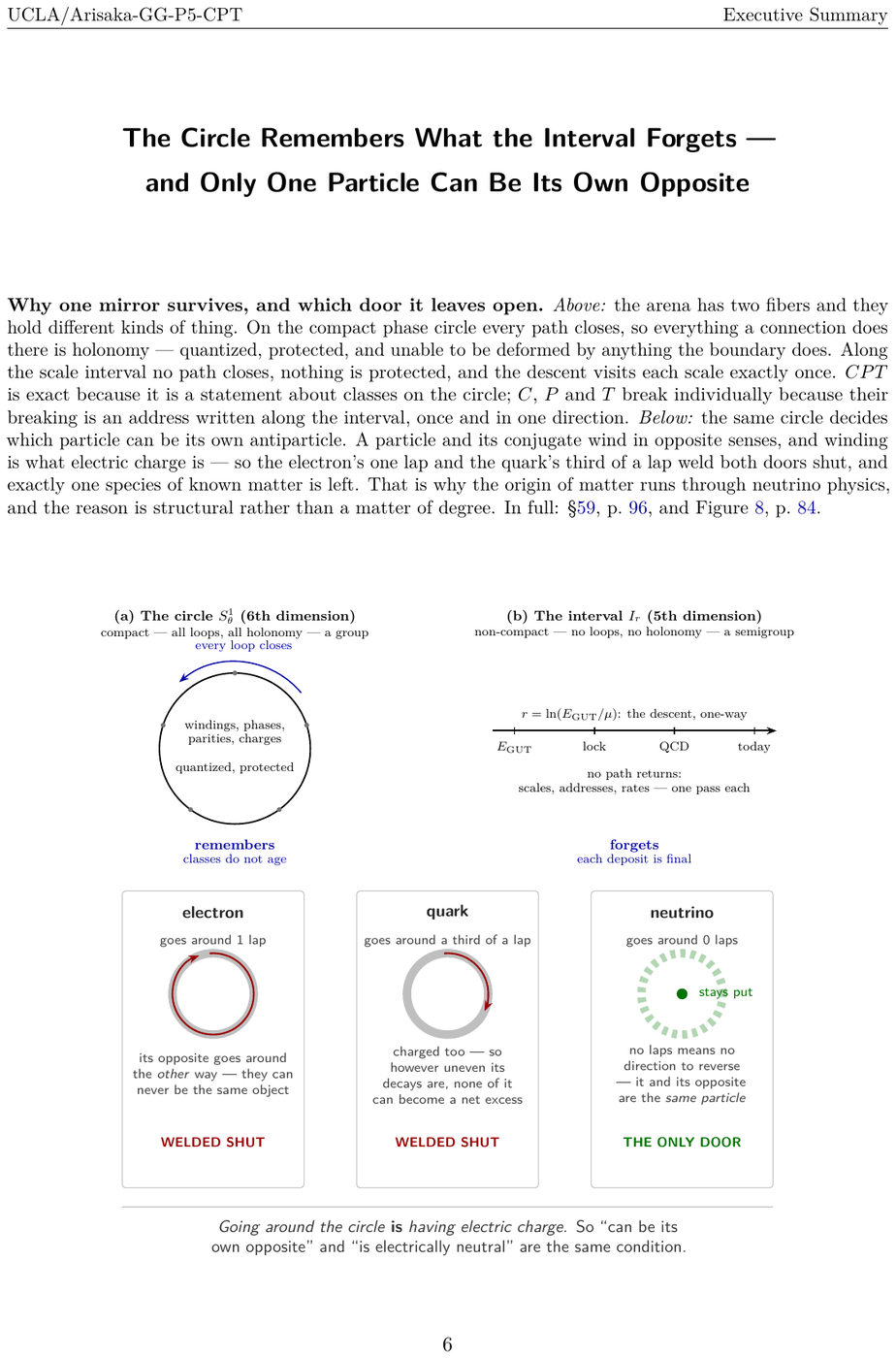
Why is there something rather than nothing? A universe born even-handed between matter and antimatter should have annihilated to light. And why do the three mirrors of nature — charge (C), space (P), and time (T) — each fail to reflect the world faithfully, while their combination CPT never fails? This paper, a member of the GG-Theory cohort's Foundations Branch, answers both questions with one idea: the mirrors are not laws but orientations. The world is built from real, oriented geometry — a compact circle, space, and a one-way clock — and C, P, and T are the reversals of those three orientations. Each can break because the geometry has texture; the total reversal CPT survives because it is the one reflection no real world can detect. The antiparticle is derived at its stated grade, not postulated: it is the same object read the other way around a real circle, and the reading forced there also locates the origin of spin- 12 and of the exclusion principle (at candidate grade). Time itself is defined by four endowments — it orders, it repeats, it opens one way, and it shelters the mathematics of the quantum world — the subject of a new Part. The receipt is quantitative: on a fully inherited ledger the quark and lepton CP phases take exact lattice values, 66.9^ and 196.4^ — the first reached by one frozen, pre-registered completion step — the neutrino masses are derived, and the universe retains about six extra particles of matter per ten billion photons — the measured excess from which chemistry, life, and mind followed. Every claim carries its grade — derived, conditional, candidate, or asserted — and the paper's tables say which. The claim is mortal: DUNE, Hyper-Kamiokande, JUNO, the ton-scale double-beta searches, and the high-luminosity LHC can each kill it within this decade, and the paper says where.
Keywords
- CPT theorem
- discrete symmetries
- charge conjugation
- parity violation
- time reversal
- antiunitarity
- Wigner's theorem
- CP violation
- Jarlskog invariant
- rephasing invariance
- flavor holonomy
- pentagonal lattice
- CKM matrix
- PMNS matrix
Showcase — 1 page from the paper
Cite this preprint
@misc{ArisakaP5,
  author       = {Arisaka, Katsushi},
  title        = {The Mirrors of Matter},
  year         = {2026},
  note         = {GG-Theory preprint P5, version v23.2},
  doi          = {10.5281/zenodo.22064329},
  url          = {https://preprints.arisaka-gg.org/p5-cpt/}
}
K. Arisaka, “The Mirrors of Matter”, GG-Theory preprint P5, v23.2 (September 9, 2026). doi:10.5281/zenodo.22064329
The cohort
The Constitution
The GG-6 Trio
The GDOS Trio
The 4D-Physics Trio
The Closing Capstone
Particle Physics Branch
Foundations Branch
Cosmology & Astrophysics
White-Paper Branch