Symmetry, Conservation, and Geometry
Seven Steps from Noether, Bianchi, to Hopkins–Singer, and the Ledger the Open-System Turn Pays Out
v23.6 · September 11, 2026 · 383 pages
Abstract
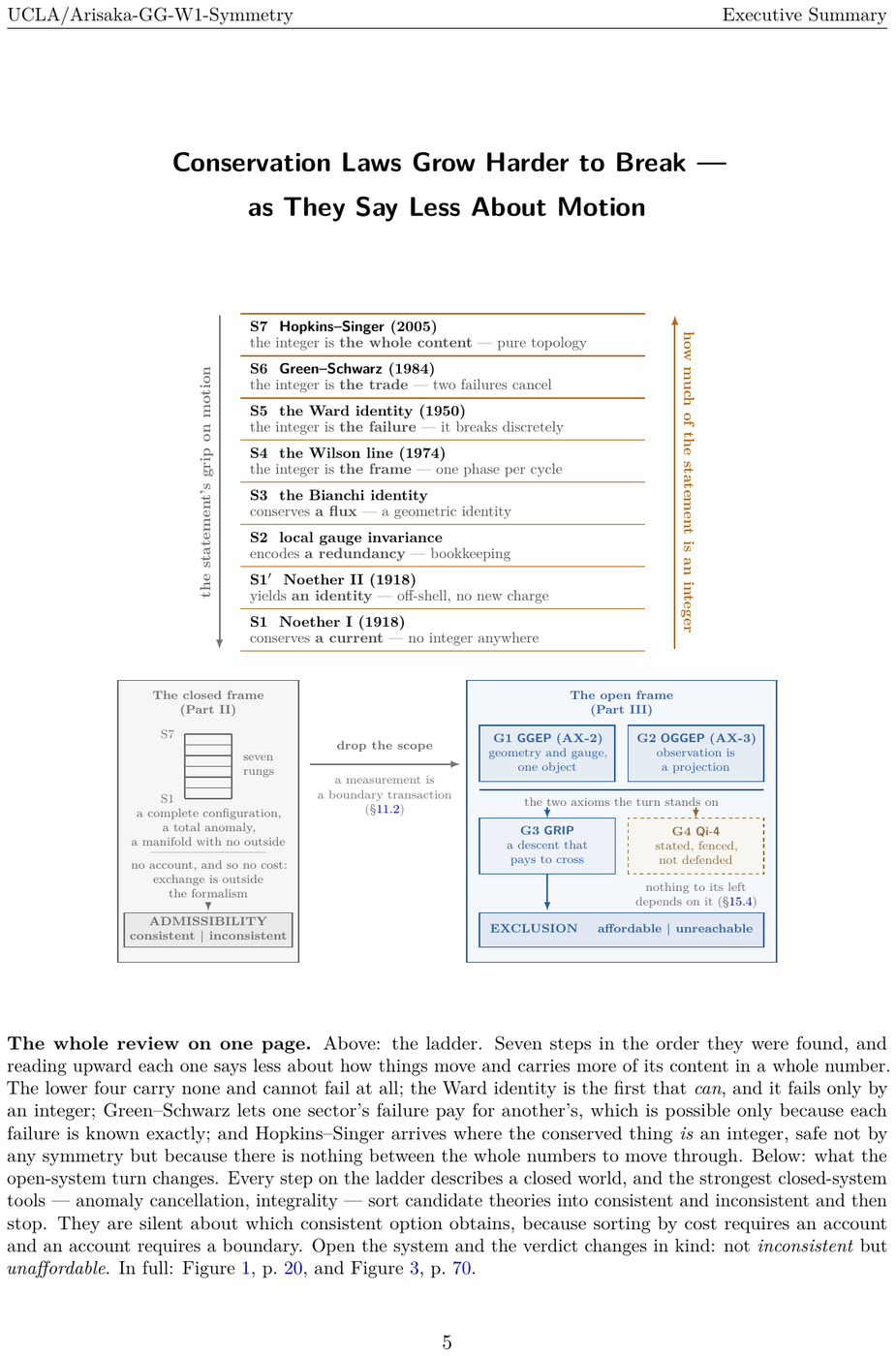
Physicists have long believed that things are conserved because the world is symmetric. This review follows that belief through the seven results that built it, in the order they were found: at each step it gives way, and what replaces it is more interesting.
Noether's first theorem ties a conserved quantity to a symmetry: a law that constrains motion. Her second theorem, in the same 1918 paper, shows that a symmetry holding independently at every point delivers no conserved quantity — only an identity, true whether or not anything obeys the equations, so gauge invariance is a redundancy in our description, not a feature of nature. The Bianchi identity conserves magnetic flux for no dynamical reason: a curvature is a curvature. Where a loop does not close, a phase survives that no curvature sees. Quantized, the identity can fail at last — and only by a whole number. Green–Schwarz then lets two failures pay for each other, and Hopkins–Singer arrives where the conserved thing is an integer, safe because integers have nowhere to move.
The sequence has a direction: conservation laws grow harder to break as they say less about motion. Parity, CP and naturalness were believed partly for their beauty, and each failed.
GG-Theory is then placed at the end of that sequence, at declared grades: a six-dimensional geometry with exact books, read off by an open boundary. Its payout is set beside the measurements — twenty-eight Standard-Model numbers and twenty-one cosmological ones, each graded, from four integers doing twenty unrelated jobs. Open books say not what cannot leave but what must be shown when something does — so the breaking of symmetry becomes not the loss of a design but the step that selects a world.
Keywords
- symmetry
- conservation laws
- Noether's theorems
- gauge invariance as redundancy
- Bianchi identity
- Wilson lines and holonomy
- the Hosotani mechanism
- Ward identities
- anomalies
- Green–Schwarz mechanism
- Hopkins–Singer quantization
- differential cohomology
- quadratic refinement
- open systems
Showcase — 1 page from the paper
Cite this preprint
@misc{ArisakaW1,
  author       = {Arisaka, Katsushi},
  title        = {Symmetry, Conservation, and Geometry},
  year         = {2026},
  note         = {GG-Theory preprint W1, version v23.6},
  doi          = {10.5281/zenodo.22064340},
  url          = {https://preprints.arisaka-gg.org/w1-symmetry/}
}
K. Arisaka, “Symmetry, Conservation, and Geometry”, GG-Theory preprint W1, v23.6 (September 11, 2026). doi:10.5281/zenodo.22064340
The cohort
The Constitution
The GG-6 Trio
The GDOS Trio
The 4D-Physics Trio
The Closing Capstone
Particle Physics Branch
Foundations Branch
Cosmology & Astrophysics
White-Paper Branch