The Hubble Tension in the Light of GG‑Theory
The Hubble Constant as One Reading of a Derived Expansion History H(t)
v23.4 · September 11, 2026 · 285 pages
Abstract
For a century, “how fast is the universe expanding?” was a question answered by measuring. By 2026 the measuring had split: read from the afterglow of the Big Bang, the rate comes out near 67 (in astronomers' units); read from the local ladder of stellar distances, 73.50 ± 0.81 — a seven-sigma gap that no single method explains.
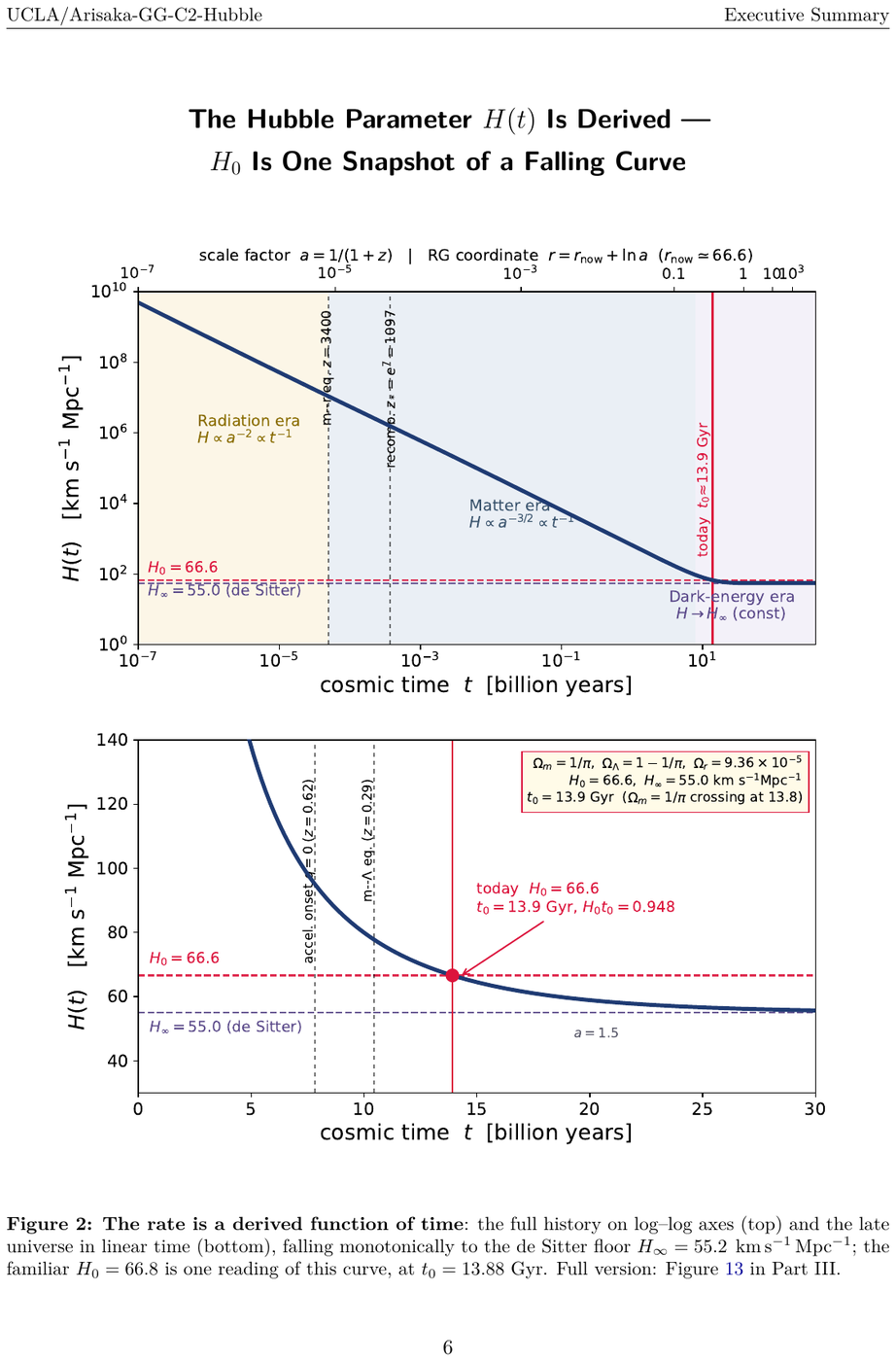
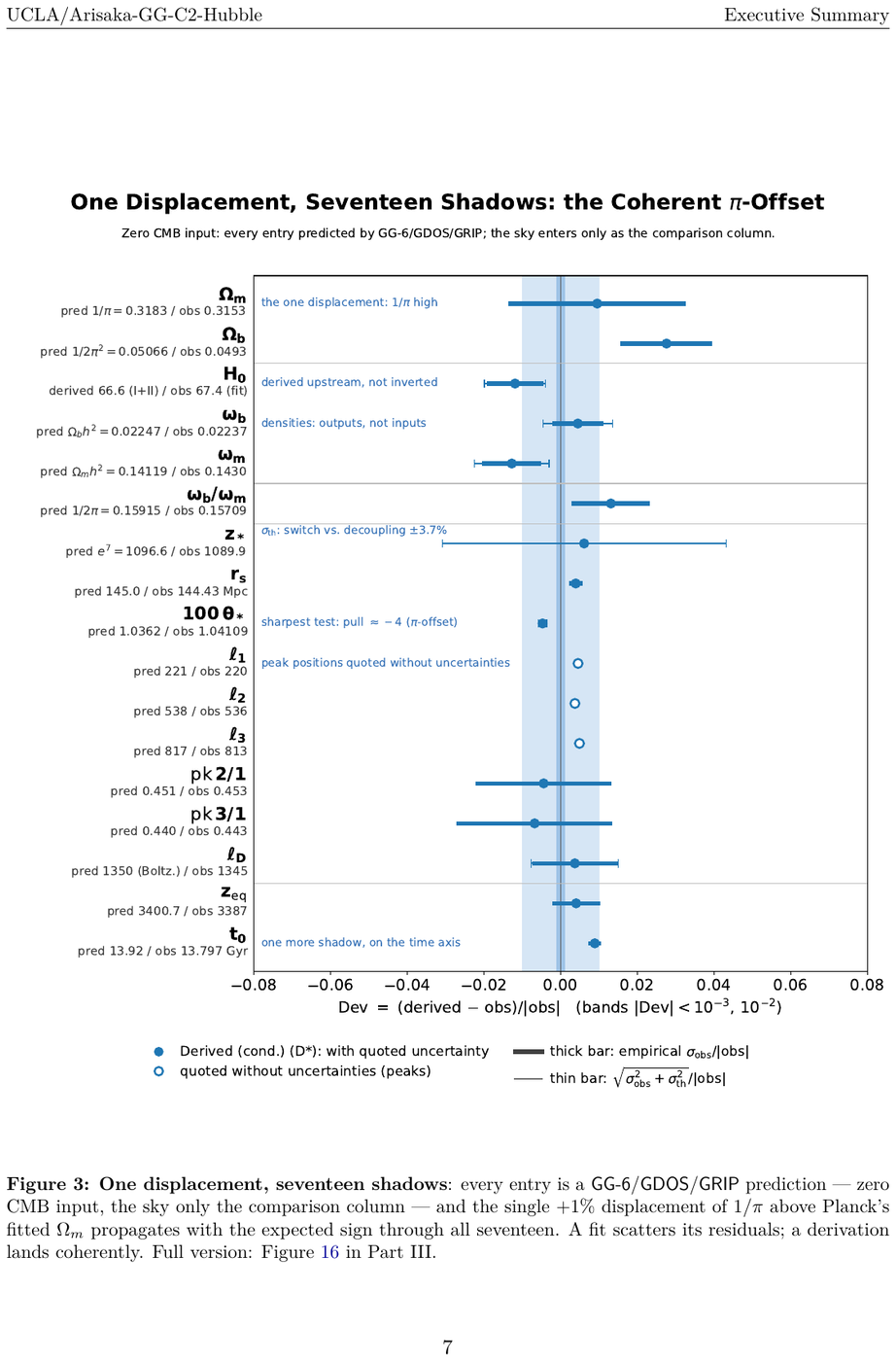
This paper reads the disagreement through GG-Theory, in which the expansion rate was never a number to be measured but a function of time to be derived: a six-dimensional geometry fixes the cosmic recipe as exact expressions in π, Einstein's equations turn that recipe into the entire history H(t), and today's value is one snapshot of the curve — expressible in a single analytic line in the three laboratory constants , G_N, ℏ and two integers of the theory's ledger, giving 66.8 ± 0.2 — on the afterglow side of the split, 1.1σ from the CMB combination. More than ten of the standard model's fitted numbers re-emerge, unfitted, at the percent level. The early measurement needs no new physics.
The local 73.5 is then the puzzle — and not, this paper's audit finds, a settled consensus: the 2026 landscape's forty-five determinations span 67–73, the seven sigma certifying one superb network's internal agreement. The paper reads the local value as the framework predicts it: one background rate, and a ten-percent calibration systematic in the ladder's rungs that the framework predicts and does not derive — confronted with the field's own published corrections, which do not yet reach it.
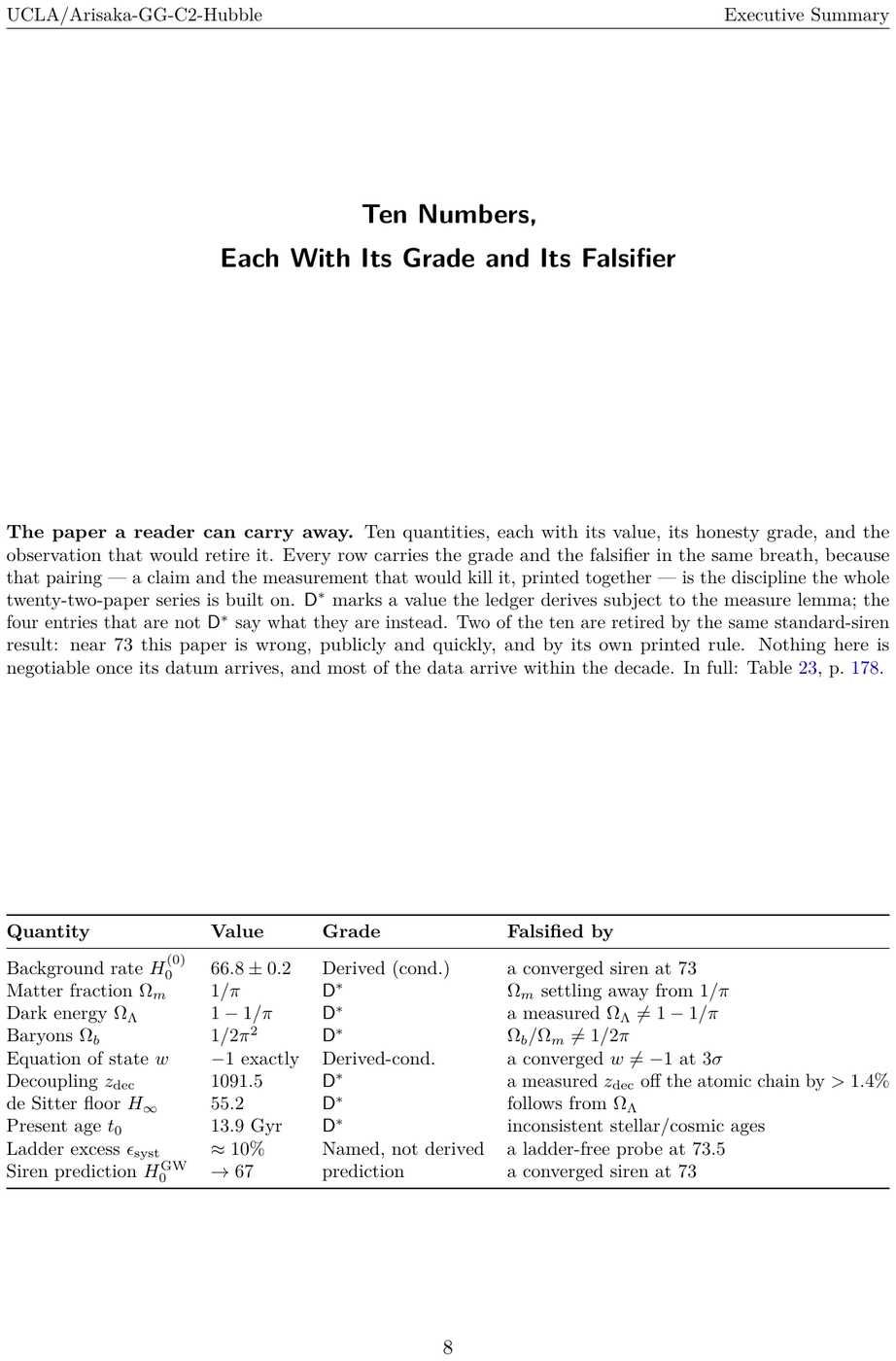
The referee is scheduled: gravitational-wave standard sirens read the rate with no ladder and no afterglow, and GG-Theory predicts they converge near 67 — about twenty-two events from now. Near 73, this paper is wrong, and says so in advance. Either way the century-old “constant” has finished its work: what remains to be tested is not a number but a law.
Keywords
- GG-Theory program
- Hubble tension
- H_0
- derived Hubble parameter H(t)
- closed-form H_0
- H0DN
- Local Distance Network
- distance ladder
- 2026 H_0 landscape
- π-locked inventory
- sound horizon
- standard sirens
- local void, priced and not carried
- distance-ladder systematics
Showcase — 3 pages from the paper
Cite this preprint
@misc{ArisakaC2,
  author       = {Arisaka, Katsushi},
  title        = {The Hubble Tension in the Light of GG-Theory},
  year         = {2026},
  note         = {GG-Theory preprint C2, version v23.4},
  doi          = {10.5281/zenodo.22064336},
  url          = {https://preprints.arisaka-gg.org/c2-hubble/}
}
K. Arisaka, “The Hubble Tension in the Light of GG-Theory”, GG-Theory preprint C2, v23.4 (September 11, 2026). doi:10.5281/zenodo.22064336
The cohort
The Constitution
The GG-6 Trio
The GDOS Trio
The 4D-Physics Trio
The Closing Capstone
Particle Physics Branch
Foundations Branch
Cosmology & Astrophysics
White-Paper Branch